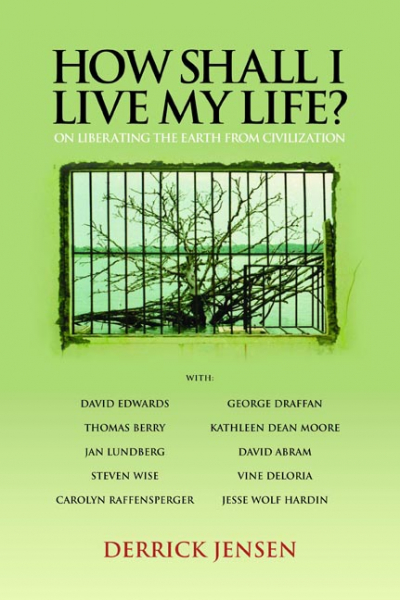
 This interview changed my life. It contains, by far, some of the most inspiring words i've ever read. Had i not discovered this interview in Derrick's book How Shall I Live My Life? last spring, i may have never lifted myself out of the numbing rut i was in and began to love and speak with my landbase. I found this copy here: http://cosmicrevolutionks.blogspot.com/2010/10/derrick-jensen-jesse-hardin.html
**
Jesse Wolf Hardin’s work and life are all about feeling. He has written that “we know that we live in order to feel- and feel in order to praise and celebrate that life. We sense and relate to the world through the complex symbiosis of emotion and instinct we call the heart, through the ‘five senses,’ and those unmeasured faculties like intuition and precognition that scientists have lumped together as the ‘sixth sense.’ While we can benefit by learning the “facts” about any chosen bioregion or terrain, we can never really know a place by reading a book on the subject, or by thinking about it. We only come to know it like a baby, humbly and appreciatively touching and tasting the world we’re a physical, integral part of… Our natural response to our being born is to pull the substance and meaning of the world closer to us, by grabbing a hold, to pull ourselves ever closer to it. In this way life ‘makes sense,’ and our senses make the experience of life.”
**
Derrick Jensen: You’ve written: “To become native again is not to emulate Native American or any other past or existing cultures, but instead to recall and relearn our own connection to and responsibilities to the regions where we presently reside.” What does that mean?
Jesse Hardin: We’re native to the degree that we enter into reciprocal relationship with the living land we’re each an integral part of. To the degree that we are not only in love with- but loyal to- the place that supports, nourishes, sustains, informs, and inspires us. To be native is to give back our full sentient presence and artful acknowledgement, our protection and affection to repay the gifts of food, home and wisdom with personal activism and heartful prayer, with restoration and celebration; to repay with our fullest living of life, while we’re alive… and with our bodies when we die.
What is essential is that we be open to the directives of the ecosystem. That we become conscious of its needs and troubles, character and flavor, integrity and health. Conscious of the essence and spirit of place.
DJ: Let’s back up a second. It seems that before we can talk about inhabiting a place, we need to talk about home.
JH: To “lose our place” is to lose our way home. Home is the heart in deep relationship with the land. And it is the place that calls us most insistently, instructs us loudest and best. The place we inevitably miss when we leave, the partner to our pain, and reason for our joy. Home is not only where you want to live, but how you want to live. And it is the place where you want to be when death finally claims you.
Let me put it this way: the source of all psychological, social, and environmental dis-ease is our illusion of separateness. And the first step in mending that artificial schism- that deep, damn wound- is to try to bring ourselves back to a place of engagement with our authentic beings, in the vital present moment.
DJ: I don’t understand.
JH: The opening to the experience of the universe, is through intimacy with a living planet, Gaia. The doorway to the experience of Gaia is through our sentient animal bodies and our feeling hearts. And the journey- the work, the realization- can only happen in immediate present time. Reindignation begins with reinhabitation of our awakened bodies and roiling emotions, in the “now”. Much of the natural world, and our own wild spirits, are dying as a direct result of our alienation and abstraction, from what I call our “great distancing.” And perhaps most tragically of all, we are dying without having fully lived.
DJ: That reminds me of a quote you use from H.G. Wells: “One can go through contemporary life fudging and evading, indulging and slacking, never really frightened nor passionately stirred, your highest moment a mere sentimental orgasm, and your first real contact with primary and elemental necessities the sweat of your deathbed.” What does this mean?
JH: It’s all too easy to acquiesce to the status quo, to the latest trends, and to our habits and fears. To give up our dreams for a meaningless career. To seek distraction in the television set and salvation in the sky. To compromise on a mate, and to pretend we’re a victim of something called fate. To reside in the busy mind, and thereby avoid the pain of the neglected body and the anguish of an untended heart. To flounder around in the superficial rather than risk the frightening depths. To accept and acquiesce rather than discern and confront. To settle for comfort and safety instead of sensation and response-ability. We civilized humans are as tourists in our animal bodies except during certain moments in the midst of the sex act… or when scared for our lives. All too often, it’s only when we face mortal or psychological destruction that we come back to the body that feels, runs, retaliates, or relieves. Back to ourselves, back home.
Clearly social and environmental activism isn’t enough, unless we can somehow change the way we as a species perceive and relate to the natural world, to land and place. We can claim all these small, short-term victories but the fact is that the world is being deforested ever faster as we speak. More toxic chemicals are being released into the ground and water than ever. We’re changing the climate. And genetic engineering poses what is perhaps the single greatest threat to the health and integrity of life on Earth.
DJ: Are we losing?
JH: I’m afraid so, at least in the short term. But the trick to right relationship- and to really being worthy of this blessing called “consciousness”- is to do what is right, what matters most, regardless of the visible results. We seldom see the ramifications of all the good we do, but more importantly, we need to make the grand effort not because we imagine we’ll succeed, but because it’s right to do so. Because it really, deeply matters to us! And in a way, even discouragement and disgust are potentially good signs. They’re evidence of an awareness of the odds stacked against us, and it is acting in spite of them that makes one’s life heroic.
DJ: Are you saying results don’t matter?
JH: Of course they matter. But we watch for results in order to figure out the best actions to take, not for a reason to act. And sometimes we’re able to accomplish the impossible. When Crazy Horse saw his family and village under attack by the U.S. Army, he could see that the odds were stacked against him, and that any resistance could be futile. In spite of this he unsheathed his weapon and rode headlong into the fight, inspiring other braves to follow his example, and breaking the enemy ranks with the sheer intensity of his effort, his investment and risk, his life and love.
To keep from feeling discouraged it helps to look past the nest two generations of getting kicked in the teeth again and again. What I live for is the realization of an epoch after technocivilization has met its ignoble end, blowing itself up, or slowing wasting away. For a time what wildlife takes back the ruins of our cities. When wild creatures stalk the shells of office buildings and malls, when the plants start growing up through the cracks in the pavement. We can’t expect to see that.
DJ: But we do. You see it all around yourself. You got the cows off of this land, and the cottonwoods and willows have come back. It’s beautiful.
JH: True. In a way I’ve been able to protect and restore more wilderness by working my butt off for it- by standing up to trespassers and developers and every other threat for all these years- than I ever did blocking logging roads. But even this single victory remains in jeopardy. I can’t find a land trust willing to take on this special riparian refuge without an attendant bank account for monitoring it. I can’t sign a conservation easement, if no one will accept it. It’s protected for now, through sweat and threat, dumb luck or an assist form the spirits. And more than that, it’s reveled in, honored, restored and resacramented… and yet there are no guarantees it can last. The best we can do is to wake up each and every day, giving thanks for being alive and aware in this enchanted place. Being who we really are, and doing everything we possibly can, for all the right reasons.
DJ: I’d like to go back to the notion of reinhabiting one’s body.
JH: Your door to the entire world is located where your feeling body touches the giving ground. Your bare feet, your rear end, the few square inches of absolute contact are points of connectivity between yourself and millions of years of organic process. And the way to fully experience that connection is by disengaging our mental tape loops, our voice tracks, the constant commentary that keeps us perpetually anticipating the future or criticizing our self about the past rather than tasting the muffin we’re eating right now. Then we can experience the world around us- as well as within us- like the awakened, hungering, feeling, responding, caring creature selves we really are.
DJ: So reihabiting one’s body is tied intimately to reinhabiting the present moment.
JH: We can’t feel our connected to the sentient body, or participate in the processes of the natural world, anywhere but “here,” and “now.” And we can’t really be either if we’re forever residing in our brains, engrossed in the movies of our minds. All the while reality waves its arms and wings and cloud forms like flags trying to win back our attention, trying to give us back our lives. I mean, there’s a reason why they call it a “present:” because it’s a gift we’re fools to miss.
Most of us have read that old science fiction classic where the professor departs his basement shop astride his “time machine,” leaving nothing behind but a ring in the dust on the floor where it once stood. In the same way civilized humanity is often out of touch, absent, unreachable by a world of unfolding presence. Our bodies remain in place like that impression in the dust, while our minds orbit backwards and forwards through the years, inhabiting every period of time but now, and every place but here. Too often we dwell on our desires and worries, rather than dwelling in the present, in place. And meanwhile things like industrial development and environmental destruction are largely accomplished out of time, by future-looking planners and bureaucrats who are oblivious to the purrs and the pleas, the rewards and challenges of the beckoning present. What we need is a conscious, collective high-dive into the always decisive moment- reimmersing ourselves in the sensations and responsibilities of the real world- now!
DJ: How does one begin to do that?
JH: Reach out to what is real- a leaf, a chair, a friend- emissaries of the present glad to reconnect us to the now. If something exists for the sense, it exists in present time. Wake up from the nightmare of past events and far away places, peer into the gradations of black in the unlit bedroom, focus on the pressures of covers against skin, or give yourself over to identifying any smells making their way to you through darkness. Try showers hotter and colder than you think you can stand, focus on the lover you’re with until there are no others. And if all else fails, there’s nothing like a loud boom, the sudden screeching of brakes, or a genuine near-death experience to bring us back into bodies ready to run or have fun.
There’s so much distraction and obstruction we have to remain fiercely focused and totally insistent. Because almost everything in society calls you away from yourself. The clamor and bright lights, standing in lines or working in offices, going to movies or making small talk. For the unplacated few, our society can seem like a very lonely place. The average Joe doesn’t seem to want to smell as deeply or love as much. Or to risk deeply caring, because it might mean he has to act on those things he sees and feels. Even the friends you’ve known forever might not affirm something that is a little bit heavier, a little deeper, than they may want to go. Maybe you becoming more of who you are mirrors something in themselves they don’t want to deal with, and so they try to keep things light. Becoming yourself makes you momentarily the loneliest person on earth, but as you walk through that door you realize that you’re part of everything. And that in the end, it’s impossible to be alone. That’s the kind of assurance and wisdom that nature affords: intimate knowledge of this moment, this tree, this place, this home.
DJ: And it seems to me to take a long time. I’ve been living on the same land now for about three years…
JH: And you’re just starting to get introduced.
DJ: Yes.
JH: This courting and bonding requires not only commitment but presence and attention, day after day after day. If we’re only home seasonally, or if we’re gone five days out of the week, it’s not the same. Deepening relationship requires we get to see the sun come up in a slightly different place each and every day through each of the four seasons. I’ve got so many friends who live in cities, who work all day indoors, and some of them don’t even know which way the sun sets. Until we’re oriented, until we know where we are, until we know what direction is East, how can we know what direction to take our lives? And it takes time to recognize the ecological cycles, as many of them are long. There are seven-year cycles for different insects, and there are different flowers that come up only every four to eight years. Patterns of rain and drought. New species moving in or disappearing. Miss a single week in this enchanted canyon, and you could miss the bulk of the wild mulberry season. No single sunset will ever be repeated again, quite the way it shined today.
This intimacy of relationship, this narrowing down of focus actually expands what it means to belong and to be alive. Unfortunately, I’m not sure that such a deep relating and reinhabiting will ever be compatible with making an income or covering one’s medical insurance.
DJ: Why not?
JH: They require we do work that takes into account the integrity and needs of our bodies, our communities, other species, the air, water and land… and that’s a hell of a way to try and make a living. This System rewards its citizens who acquiesce, compromise and conform. We’re usually paid not only to do what we’re told, but to “look the other way”- away from the effects of our tasks on our bodies, our families and our world. In fact, the more meaningless or destructive the position, the more money and benefits we can make. Corporate heads and politicians, geneticists and nuclear engineers, army generals and real estate developers are highly paid. Writers and dancers, preschool teachers and counselors, environmental activists and those who run food programs for the poor, wilderness restorationists and sage poets are lucky to be paid at all. Or else they’re volunteers.
Bu there’s an upside to this. Since the fields that require caring help pay so little, they tend to attract the most sincere people. People who are doing their service for the purest of reasons.
DJ: What’s your story?
JH: There never really was a time when I felt like I fit in. There was never a moment I didn’t feel alienated from the social agreement.
DJ: What social agreement?
JH: That if we mind our “p’s” and q’s” everything will be alright, medicine will find a cure for death, science will erect bubbles over our cities to purify the air, we’ll meet Mr. or Ms. Right, the oil companies will come up with new forms of inexpensive energy, taking away our privacy is their way of protecting us, building more missile systems will make us safer, Social Security will really take care of us when we get old, and we can all have lots of babies with no serious effects on the environment or our quality of life. And in the end, if we play by the rules we’ll all go to heaven where there are no endangered species or slaughtered Hutu tribesmen, nor wives being beaten by husbands with no self-respect.
The agreement is that we’ll smile even if we don’t like someone or something, and gather on Christmas and give presents even to those family members who happen to resent us the rest of the year. That we’ll ignore the child abuse we know is going on across the street, and have secretive affairs rather than be honest with our spouse about our feelings and needs. That we won’t talk about the effects of pesticides we sprayed in our well trimmed yards this afternoon, the percentage of poor uneducated kids in the military, or the reasons for unwed mothers and chemically deformed babies.
Do you remember a magazine in dentists’ offices when we were kids, called Highlights? Do you remember the page where they’d show a picture with something out of place, like a hammer hanging from a tree, and you were supposed to figure out what was “wrong with the picture?” From the time I was a toddler it’s felt like that to me. It’s like tapping on the rocks and discovering they’re hollow, finding mold marks and seams once we look close enough at trees. It’s like we’re all living in a big theme park… and we have to pay to get out.
When I started running away from school at age fourteen, I found bouts of hunger more stimulating than daily doses of tasteless frozen dinners, and liked being lost better than always thinking I knew where I was going. Safety was a numbing straitjacket, so I embraced risk. I welcomed the pain, because I couldn’t stomach denial anymore.
Read the rest here: http://cosmicrevolutionks.blogspot.com/2010/10/derrick-jensen-jesse-hardin.html


